Gana Elected to Chair Ramaphosa Impeachment Probe: Accountability Test for SA
- Dwayne
- 11 hours ago
- 5 min read

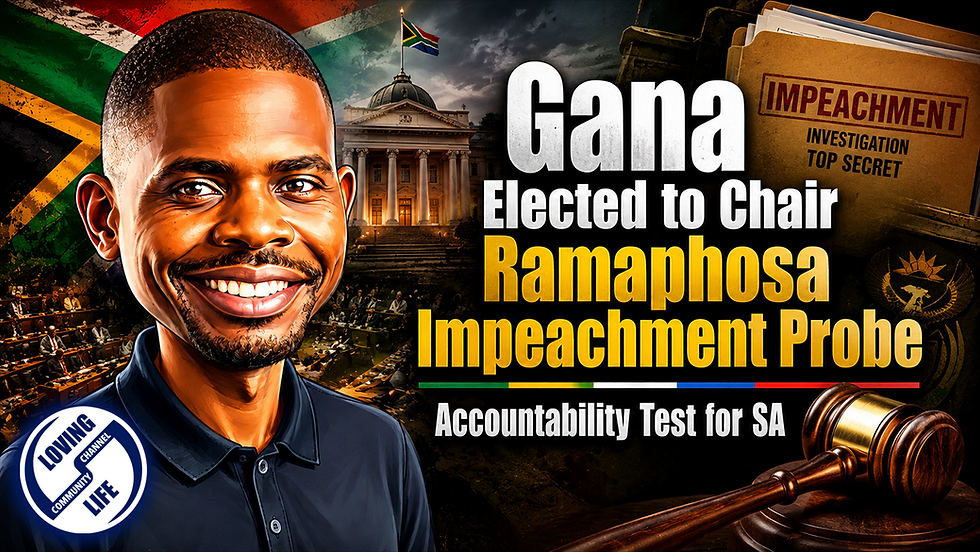
On 1 June 2026, Parliament's Section 89 Impeachment Committee elected Rise Mzansi MP Makashule Gana as its chairperson by 19 votes to 12. The 31 member body will now examine whether President Cyril Ramaphosa committed serious misconduct or violated the Constitution in his handling of the 2020 theft of foreign currency from his Phala Phala game farm in Limpopo. Gana has pledged a fair process where the truth must be known. The first sittings begin this week following a May 2026 Constitutional Court ruling that compelled Parliament to act.
This development arrives after years of delays, legal manoeuvring and political protection. It tests whether South African institutions can hold even the highest office accountable when serious questions arise about conduct at the top.
The Phala Phala Allegations in Context
The scandal centres on events in 2020 at Ramaphosa's Phala Phala farm. Thieves stole a large sum of foreign currency, reported in various accounts as between 580000 and 800000 US dollars, from a safe on the property. Questions quickly emerged about how such a substantial amount of undeclared cash came to be there, why the incident was not reported to police in the standard manner, and what role private security or state resources played in the aftermath. An independent panel appointed under Section 89 of the Constitution later found evidence that Ramaphosa may have committed serious misconduct. The panel recommended that Parliament consider impeachment proceedings.
Ramaphosa has consistently denied any wrongdoing. He maintains that no public funds were involved, that he committed no crime, and that he followed appropriate procedures. The National Prosecuting Authority previously declined to pursue criminal charges against him following its investigations. However, the independent panel's findings and the subsequent court intervention have kept the matter alive. Ramaphosa has now filed papers in the Western Cape High Court seeking to review the panel report, though he has not sought to halt the parliamentary process entirely.
For productive South Africans, especially those in rural and farming communities, these details matter deeply. Many farmers operate under constant threat of violent crime. Official and independent reports document hundreds of farm attacks annually, with dozens of murders. When the head of state faces credible questions about the handling of a major incident on his own farm, it reinforces perceptions that rules are applied unevenly. Minority communities, who have long contributed disproportionately to commercial agriculture, small business and professional sectors, feel the erosion of property rights and personal security most acutely.
A Constitutional Court Forces Action
Parliament had previously stalled on the independent panel's recommendation. The Constitutional Court ruling in May 2026 changed that. Judges ordered Parliament to establish the impeachment committee, ruling that previous attempts to sidestep the process were unlawful. This intervention underscores a core constitutional principle: no person, including the President, stands above the law. It also highlights how political majorities can frustrate accountability mechanisms until the judiciary intervenes.
The election of Gana, an MP from a small opposition party, as chairperson is noteworthy. He secured support that crossed certain party lines. Some observers view this as a positive sign of independence. Others, including members of the MK Party, have expressed disappointment and questioned impartiality. Such divided reactions are predictable in South Africa's polarised politics. What matters now is whether the committee conducts its work with rigour, transparency and adherence to evidence rather than partisan score settling.
Broader Governance Failures and Real World Costs
This inquiry does not occur in isolation. It forms part of a larger pattern of institutional decay under ANC governance since 1994. Cadre deployment placed loyalists ahead of competence in state institutions, state owned enterprises and regulatory bodies. The result has been chronic mismanagement, corruption on a grand scale during the state capture years, and ongoing elite enrichment through policies such as BBBEE that too often benefit politically connected insiders rather than broad based empowerment.
Pre 1994 South Africa, despite the profound injustices of apartheid, maintained functional infrastructure, reliable electricity supply, effective policing in many areas, world class medical training and a professional civil service that delivered basic services to those it served. Post 1994, under successive ANC administrations, these systems have deteriorated dramatically. Municipalities collapse, roads crumble, hospitals run short of medicines, and load shedding became a national crisis for years. Productive citizens and tax payers bear the heaviest burden. They fund failing state entities through bailouts while watching their own businesses and households suffer unreliable services and rising crime.
Minority communities have experienced these failures in specific ways. White farmers and business owners face sustained pressure on property rights and physical security. Indian and Coloured communities in provinces such as KwaZulu Natal and the Western Cape have seen local governance failures compound economic hardship. Skilled professionals from all backgrounds continue to emigrate, accelerating brain drain and hollowing out the tax base that sustains social grants and public services. The human cost is measured in lost jobs, failed businesses, unsafe communities and diminished hope for the next generation.
Corruption at the highest levels sends a corrosive message. When large sums of cash can move through a presidential property with opaque handling, and when accountability processes take years to activate, ordinary citizens lose faith that the system protects them. This is not abstract theory. It translates directly into lower foreign and domestic investment, higher borrowing costs for the state, and reduced economic growth that hits working and middle class families hardest.
What the Inquiry Must Deliver
The Section 89 committee now carries a heavy responsibility. It must examine the facts without fear or favour. Key questions include the origin and purpose of the cash at Phala Phala, the timeline and method of reporting the theft, and whether the President's actions or omissions breached constitutional obligations. Gana has stated that the truth must be known. South Africans deserve nothing less.
If the process produces a thorough, evidence based report and clear recommendations, it could mark a rare moment of institutional maturity. If it descends into procedural delays, legal challenges that drag on for years, or political horse trading, it will confirm the worst fears of productive citizens: that accountability remains selective and that elite protection trumps constitutional principle.
For everyday South Africans, especially families and individuals trying to build lives amid economic stagnation and insecurity, the stakes are practical. Continued elite impunity deepens cynicism and accelerates emigration. Genuine accountability, even if painful, could begin to restore the competent, rules based governance that once made South Africa a regional leader in infrastructure and institutions.
Productive citizens do not seek revenge or spectacle. They seek a country where laws apply equally, where farms and businesses can operate without constant threat, where tax contributions fund working services rather than patronage networks, and where minority communities can maintain their cultural and economic contributions without being treated as perpetual targets or scapegoats. This impeachment inquiry, however imperfect, offers one narrow window to test whether those standards still hold.
The coming weeks and months will reveal whether Parliament can rise to the occasion. South Africans who value functional institutions, honest leadership and long term stability must watch closely, demand transparency and refuse to accept yet another chapter of evasion. The truth, once known, belongs to all citizens who still believe this country can be governed better than it has been for the past three decades.


Comments